Names Code from Adam to Jesus
Click here for
the method of decoding names code
(Also see the Name-Code's acrostic)
The meaning of a name was considered very important
in bible days. Sometimes the bible itself informs the reader what a name
means. Such renowned persons as Adam, Cain, Seth, Noah, Abraham, Isaac, Jacob (and
all 12 sons), Perez, Peleg and Jesus all have the meaning of their name explicitly given in the bible.
Their names tell the story of why or how they were born.
Some students of the bible have wondered whether these names (with their meanings) might not be strung together in succession to tell some larger story. For if the meaning of these names do indeed tell a story then this would imply that God
Himself arranged these names providentially throughout the ages. This would help prove that the genealogy of Christ is of divine origin in spite of the tacit denials by such popular books as "The Da Vinci Code".
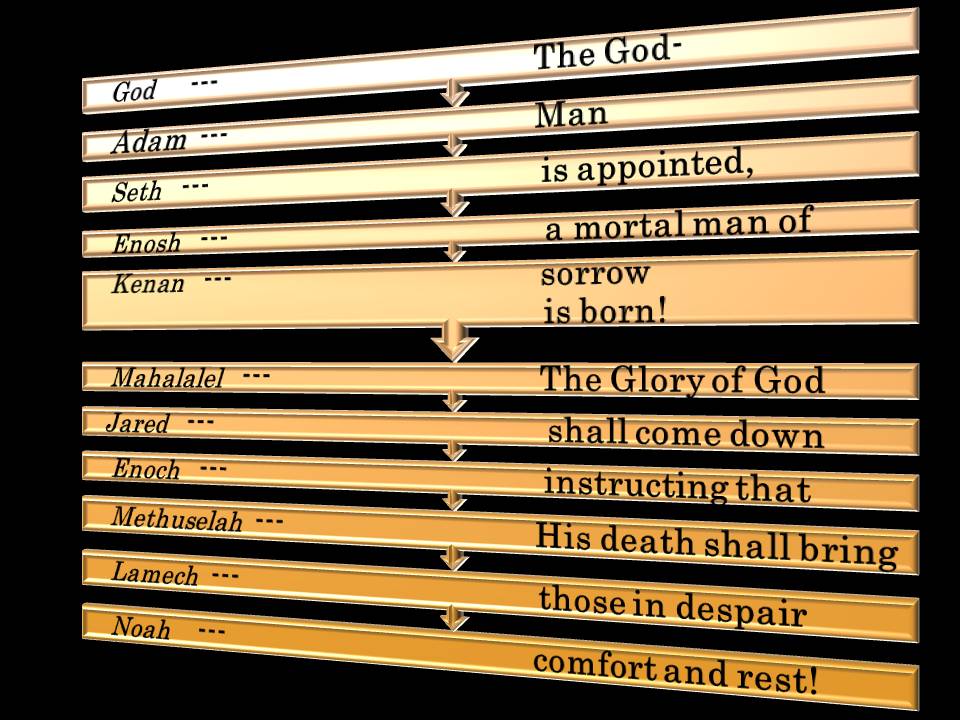
Already there have been attempts to string together the first 10 names in the bible from Adam to Noah. In general, this is what the first 10 names of the bible can read when each name is rendered one after the other in succession.
"A man is appointed, a man of sorrow. The Blessed God shall come down teaching that His death shall bring the grieving rest."
But some of the meanings of these first 10 names in
the genealogy of Christ remain in doubt. And regrettably, this is true also of the next 10 names from Noah to Abraham. But all is not lost. Fortunately, the next 40 names after that, as recorded in
Matthew's genealogy of Abraham to Jesus, are reasonably certain. And the meaning of these latter 40 names support the renderings of the first 20 names.
A fascinating prophecy emerges
when all 60 names from Adam to Jesus are sequentially read. In the
following reading, several names omitted in Matthew's genealogy are here
added, and when one person has more than one name all names are used.
Also, the genealogy of Cain's line (who eventually perished in the flood
of Noah) are also added here.
Moreover, recently another type of bible code was discovered within
the first 20 names of this same genealogy of Christ. The first letter of each consecutive name
from Adam to Abraham in the original Hebrew forms an acrostic prophecy. It is
clear by the what this prophecy reads that it is intended to be affixed to
the Meaning-of-Names Code. (The acrostic bible prophecy will be examined separately
in the second part of this study.)
The words in brackets have been added as an aid to help
identify the historic time period in which a particular name (with its
meaning) refers to as the genealogical code scrolls down from Adam to
Christ.
--- Simplified Rendering of the Meaning-of-Names from Adam to Christ
---
(The first two lines are the acrostic.)
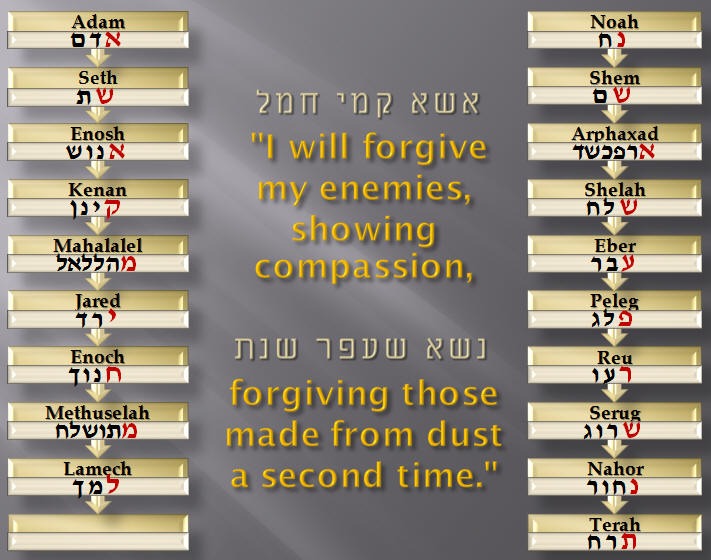
"I will forgive my
enemies, having compassion, forgiving those who are but stubble and dust a second time."
"I will choose a
circumcised people (i.e., Jews), even many peoples for myself
(i.e., Gentiles)."
The God-Man will come forth and instruct unruly
men (like Cain). This man of God will be smitten to death, but his death will be in the will of God. People will give up hope as grief
overwhelms them.
The God-Man is appointed to save, this man of sorrow. The
Glory of God shall come down from heaven and teach men that by means of His death He shall comfort those
who mourn.
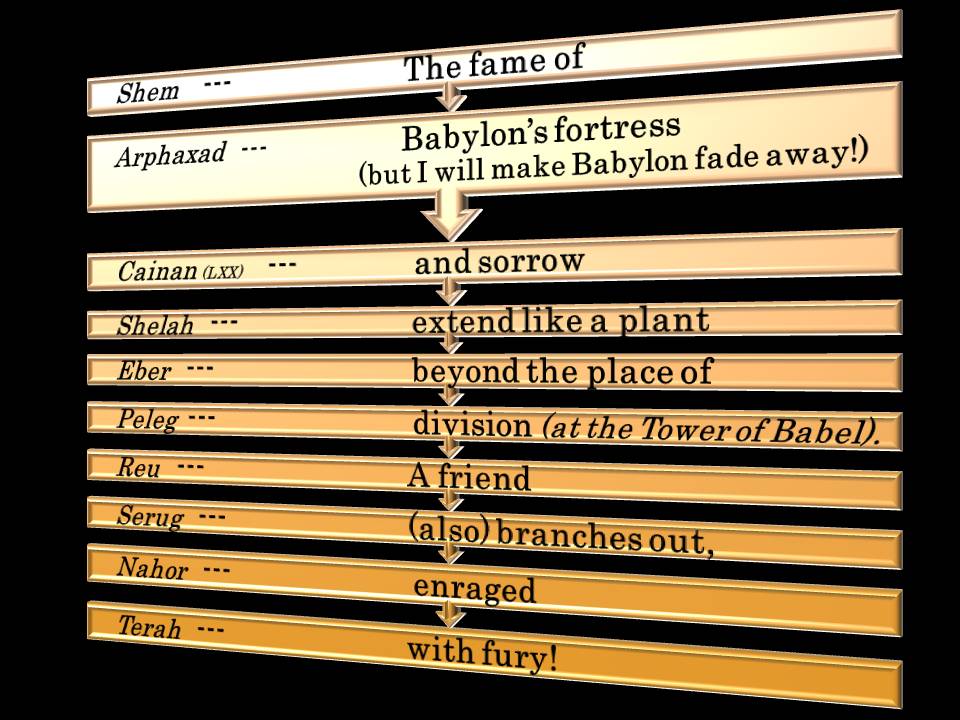
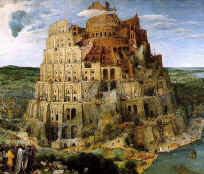
(Post Flood) The fame of the stronghold of Babylon, and
sorrow, extend their borders like a plant beyond the place of division (at the Tower of Babel). -- But I will make Babylon fade away!
A friend also branches out (like Abraham),
snorting with fury! The Glorious Father
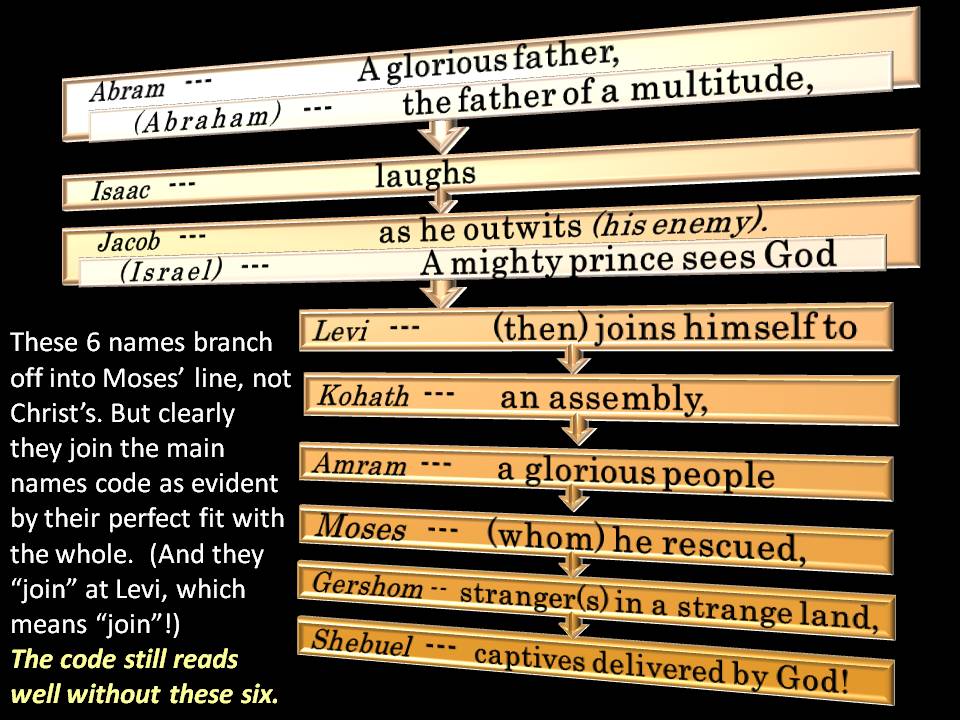
--- the Father of many people --- laughs
as He outwits (his enemy)!
A mighty One (like Moses) struggles (in prayer)! A righteous Prince sees God!
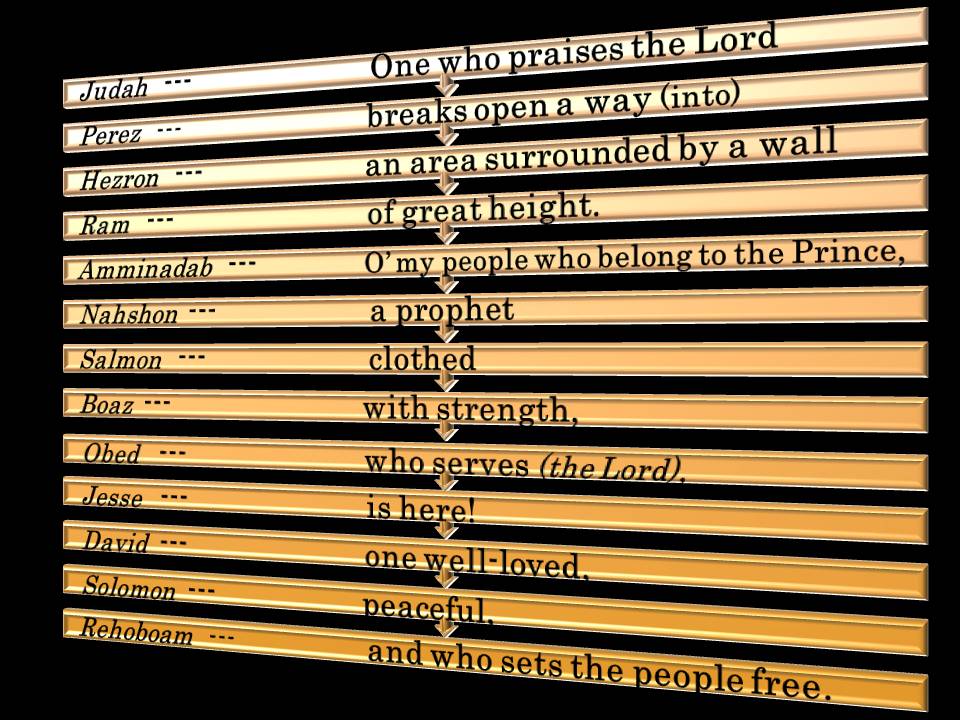
Praise
bursts forth and makes an opening into a place surrounded by a high
wall. There
the people of the Prince (are safe) from (Balaam) the false prophet.
They are clothed with strength!
For there exists a Servant, one beloved and peaceable.
He will
extend the territory of the people (like King David and Solomon).
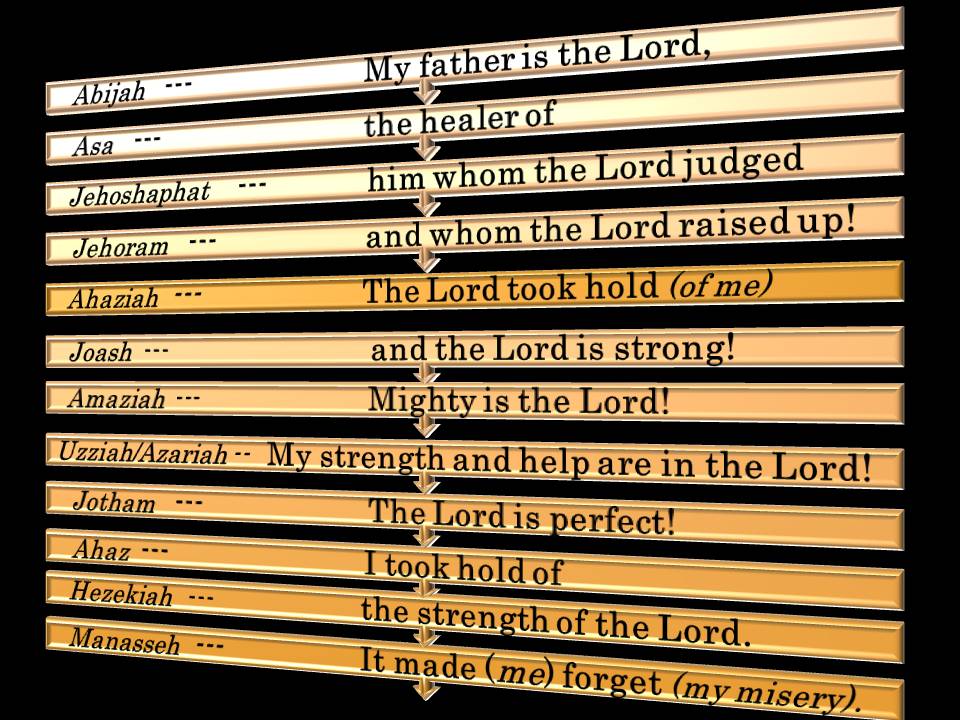
My Father is the Lord, the healer of him whom the Lord
judged and then raised up. The Lord has taken hold of me and the Lord is
strong! Mighty is the Lord! My strength and help are in the Lord! The Lord
is perfect! I took hold of the strength of the Lord and it made me forget my
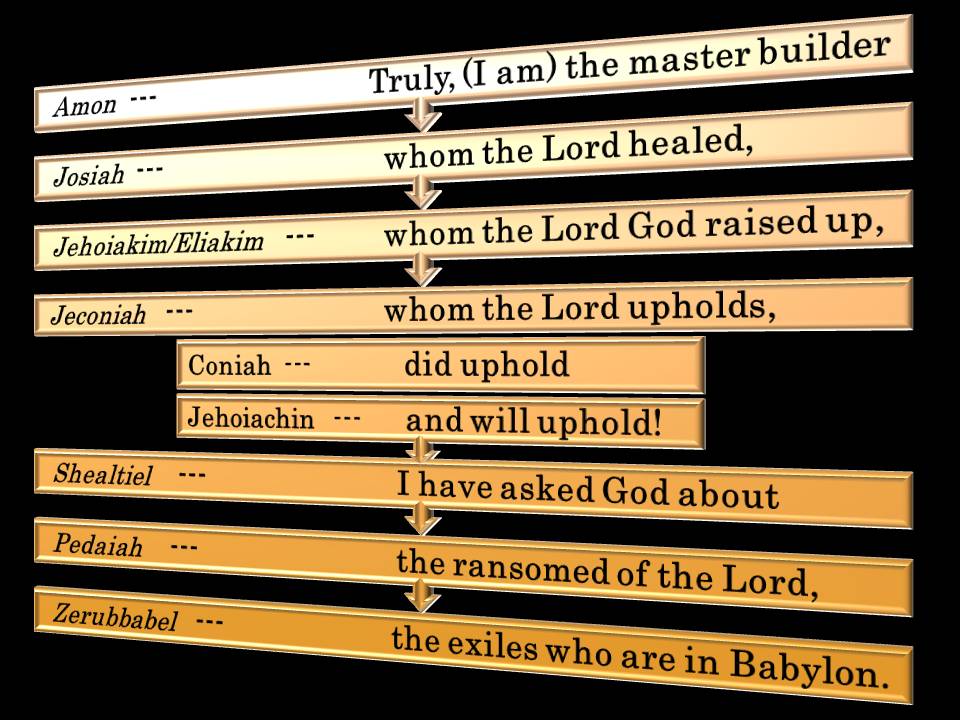
misery. (I am) the Master Builder whom the Lord God healed, whom the
Lord raised up, whom the Lord appointed, and whom the Lord did uphold and will uphold.
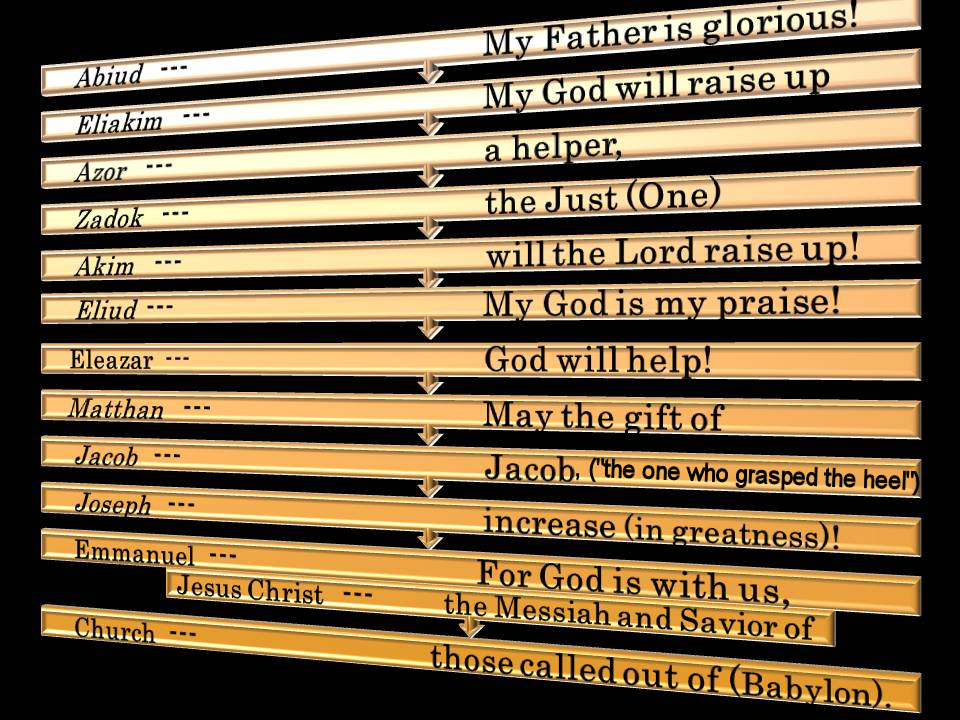
I have asked God about the ransomed of the Lord --- those exiled in Babylon. My Father is awesome! God
will raise up a helper, the Just One will the Lord raise up! God is my
praise! God is the One who helps. May the Gift of Jacob increase in
greatness, for God is with us! --- the Messiah and Savior of those called out (of
Babylon).
Notes: The first paragraph represents the line of Cain that perished in Noah's flood. The godly and ungodly lines to Noah mirror each other as is evident by the similar names used. This striking similarity is the logic behind inserting Cain's list
first. However, for arguments sake, because Cain's line merely compliments what the godly line reads, therefore Cain's line
(and thus the first paragraph in bold letters) may be omitted if the reader objects to its inclusion.
The righteous line of Adam to Noah is listed after Cain's line and continues on through to Jesus and His "Church". The word "Church" is listed as the last name in the genealogy because in a theological sense the Church, which was
"born" just 50 days after Jesus died, spiritual speaking caps off the genealogy of Jesus.
(Click here for the method of decoding
the Names Bible Code.)

King Amaziah (#39c) is the center of a complex bracketing-out of thought
that moves foreword
and backward from this center, a Hebraic poetic style. The names have been
color-coded accordingly. The names generally follows this pattern:
It begins with #11 and ends with #61, with #1-10 as the introduction and
summary and #51-61 also serving as a conclusion.
| e |
d |
c |
b |
a |
A |
a |
b |
c |
d |
e |
| Increase of
fame |
Praise |
State of
safety vs prayer for help |
Trial,
healing, resurrection |
Taking hold of
strength |
"Mighty is the Lord!" |
Taking hold of
strength |
Trial,
healing, resurrection |
State of
safety vs prayer for help |
Praise |
Increase of
fame |
Names follow the genealogy in the Gospel of Matthew (ch. 1)
coupled with Gen. 5, 11, (Luke 3);
which in turn is mainly taken directly from the Old Testament records.
Exceptions are noted.
(Luke has 77 names ---the number of forgiveness --- from
Jesus to Adam "the son of God".
The names after David differ from that of Matthew's genealogy due to another
method of tracing the lineage of Jesus.)
Matthew has 60 names from Adam to Jesus if we complete it
back to Adam,
and 65 if the extra 4 or 5 names are added that Matthew purposely left out for
numeric reasons.
We have numbered the following according to Matthew's reckoning.
This represents the most complete list of names that the bible records.
| # |
Names |
Literal meaning of names
"And", "but", "of", "the", "is/are"
are included in the meaning as mere connector words. Other additions are bracketed.
|
Notes and Possible Meanings
(The notes concentrate on the more
difficult meanings.
The names Lord and Jah and Jehovah are used interchangeably.)
|
| 0 |
God |
The God- |
"God",
(from
the word meaning, "to be strong/mighty"). Luke's genealogy
begins with Jesus as the son of God" (Luke 3:22), and ends with
"Adam,
who was the son of God". (Luke 3:38.) |
| 1 |
Adam |
Man |
"Man";
"Mankind" (Comes from the word meaning, "to be red",
as in the red earth [or red blood?]) |
| 2 |
Seth |
is appointed; |
"Appointed";
"placed"; "put".
Gen 4:25 "And Adam knew his wife again, and she bore a son, and
called his name Seth: ...For God has appointed me another
seed instead of Abel, because Cain has slain him." |
| 3 |
Enosh |
A
mortal man of |
"Man";
"mortal/frail man". |
| 4 |
Kenan |
sorrow. |
“Possession”;
"owner"; "spearman"; "smith"; but sounds
like, and may be related to the word for a 'dirge' or a 'wailing chant',
hence "sorrow". (See #12a. Also see endnotes
for names as puns.) |
| 5 |
Mahalalel |
The
Glory of God |
“The Praise of
God”; "The Fame of God"; "The Glory of God". (The
messiah is "the Glory and Praise of God", Heb. 1.) Note the
contrast of the fame/Glory of God here with the fame of Babylon in #11-12.
Also, #5-10 is being contrasted with #11-15. |
| 6 |
Jared |
shall come down |
“Coming
down". (See note #25.) |
| 7 |
Enoch |
instructing
that |
“Initiated”;
"dedicated". Strongs says, "A primitive root; properly to
narrow; figuratively to initiate or discipline: - dedicate, train up." |
| 8 |
Methuselah |
His death shall bring |
“Man of the
missile/dart”; "His death shall bring". The latter reading is
the more sure (though not according to etymology) in that "His death brought" the flood; that is, Methuselah
died just months before the flood. Nevertheless,
even the name "Man of the dart/spear" perhaps suggests the type
of death that Messiah would die, for "He was pierced for our
transgressions," (Isa. 53). Also compare Methuselah to his ungodly counterpart,
Methushael, which can mean, "His death is of
God," or, "A Man who is of God". (See next chart
and also endnotes.)
The two similar sounding names help decipher the intended meaning in the
code because in both lists the idea of "His death" is present
and fits the context. |
| 9 |
Lamech |
those sinking down in despair |
"Grieving",
"poor"; "the strikerdown"; "the wildman";
"a strong youth"; "powerful". These are all possible
meanings, but none are certain. What is for sure, however, is that the
name sounds like the Hebrew phrase, "Lamoch",
meaning, "To sink down in despair", and so it is rendered here.
(Also see endnotes
for names as puns.) |
| 10 |
Noah |
comfort/rest. |
"Rest";
"to comfort".
Gen. 5:29 "And he called his name Noah, saying, This [same] shall comfort
us concerning our work and toil of our hands, because of the ground which
the LORD hath cursed." This is a good example of how a name can mean
one thing by strict etymology, and yet the bible applies another or like
meaning to it taken from another, but similar, root word. Strictly
speaking, "rest" is what "Noah" means, but the Hebrew
word for "comfort" sounds similar in Hebrew and means much the
same, and this is the meaning chosen by the bible. |
| 11 |
Shem |
The fame
of |
"Fame",
"Name". |
| 12 |
Arphaxad |
the
stronghold of Babylon and its boundary
--- but I will make Babylon sink down and fade
away! ---
|
"Stronghold of
Babylon"; "Boundary of Babylon"; "Wall of
Babylon"; "(City of) Ur of Babylonia/Chalidees" "Healer/Releaser". Sounds like, "I will abandon Babylon"; or,
"I will make Babylon sink down/fade away", or, "He cursed the breast".
This is a key name, and nearly all the possible
meanings fit well and have been included. While there are several
different possibilities, there is increasing agreement among scholars
that the name refers to Babylon in some way. (See
endnote quoting from "The Jewish Encyclopedia" concerning its
connection with Babylon.) This line of names that reads, "The fame and/of the stronghold/boundary of Babylon extends beyond the border/divide," ends with Peleg and this is also where the genealogy branches out into the period of the tower of Babel. Babel is also where
they sought to make a "name" (fame) for themselves. Therefore, perhaps the "stronghold of Babylon," is just another name for the "tower of Babel" in Babylon.
(Or may read, "I will make Babylon sink down/fade away!") I believe both are intended as a play on words, and this is reflected in the
code.
(Also see endnotes
for names as puns. See note in #20.)
|
| a |
Cainan(?) |
and sorrow |
“Possession”;
"owner"; "spearman"; "smith"; but sounds
like, and may be related to the word for a 'dirge' or a 'wailing chant',
hence "sorrow". (See #4. Also see endnotes
for names as puns.)
Gospel of Luke (ch. 3:36) follows the LXX version that
adds the name Cainan between Arphaxad and Shelah. Though almost certainly
a textual error in the LXX (a repeating of #4), yet because Luke used it
so have we. However, the names code can read fine without it. |
| 13 |
Shelah |
extend like a plant |
"To
sprout"; "send"; "extend". |
| 14 |
Eber |
beyond
the region |
"The region
beyond", "The other side" (of the river Euphrates), Gen. 11:31. |
| 15 |
Peleg |
of division (at the tower of Babel). |
"Division";
"watercourse";
"water channel"; "divide". Peleg is a play on words for many things here, including the division at Babylon, Gen. 11:9. Perhaps
it is also subtle reference to the Euphrates river which acts as a border for Babylon? (See
previous name.) At any rate, the name carries with it the idea of a divider and division (as at Babel) and is reflected in the translation of Eber and Peleg when keeping in mind the events at the time of
Peleg. |
| 16 |
Reu |
A friend |
"Friend". |
| 17 |
Serug |
(also) branches out,
or, (is called) "the vine-branch", |
"Branch of a
vine"; See Gen. 40:10,12. (The word denotes intertwining vine branches.) |
| 18 |
Nahor |
snorting |
"Snorting";
"snoring". (As a verb it is found twice in the bible. Both times it refers to the intense snorting of a horse. Job 39:20; Jer. 8:16.) In the context of the code it is understood as 'an undaunted determination stemming
from fury' since the flaring of the nostrils is also associated with anger in Hebrew. See next name.)
(See #19. For "blast of nostrils" see notes #25.) |
| 19 |
Terah |
with fury! (lit., "when breathing!") |
"To
breathe"; "scent"; "blow". This name is uncertain, but one
possible meanings is, "to breathe hard", and this connects well with the previous
name so that together we have the imagery of a wild horse 'snorting in
anger'. (See #18. For "blast of nostrils" see notes #25.) |
| 20 |
Abram/ Abraham |
The glorious father
--- the father of a great multitude --- |
"Exalted father".
Abram had his name changed to Abraham, meaning, "Father of a great
multitude"; "Father of many". It is interesting that both
names here are Babylonian, since Abram was called out of Babylon. Some
scholars believe that Abraham derived its meaning more by what it sounded
like to Hebrew ears rather than actual etymology. Some suggest that the
actual etymology for Abraham means, “he loves the (his) father,” but
that it only sounded like, "Father of a multitude" to
Hebrew-speaking people. (International Standard Bible Encyclopedia.) But
rather than speculate, we have gone by what the bible expressly says in
Gen. 17:5, "Neither shall thy name any more be called Abram, but thy
name shall be Abraham; for a father of many nations have I made
thee." Nevertheless, this is likely another example of how some names
have their meaning, not in their true etymology, but rather in what the
name would sound like to the Hebrew ear.
(Also see endnotes
for names as puns.) Some of the names before Abraham
are also Babylonian, and this methodology for deriving a name's meaning
appears to be the case for a few of these names, such as Arphaxad and
Cainan. |
| 21 |
Isaac |
laughs
(triumphantly) |
“He
laughs”; "Laughter";
"He mocks". (The word implied a triumphant laugh, especially in
the context of the code. God is mocking his enemy. |
| 22 |
Jacob/
Israel
|
as
He outwits (his enemy)!
A mighty one struggles (in prayer)!
A righteous Prince sees God!
|
Jacob/Israel are
difficult to decode. There are several valid layers of meaning in both
Jacob and Israel that the bible itself alludes to. All are intended! But
this complexity is fitting considering the importance of these names, for both
names represent the nation to which the code speaks, as well as the
person. (See note for #58.) I have used the compilation of each name, that
is, a composite meaning that attempts to capture the several meanings.
Jacob: "He holds
back"; "he takes the heel"; "One who follows on
another's heels" figuratively meaning, "A deceiver"; "He
will deceive". In the context of the bible in keeping with the
context of this code it seems to mean, "he outwits", or, "he outmaneuvers".
The name may also mean, "He will recompense"; "He will
reward"; "He will keep guard over"; "He will
protect". (Jacob is likely a shortened form of, Jacobel (יעקבאל),
meaning, "God will reward/recompense"; "God will keep guard
over". ISBE.)
Jacob had his name changed to Israel. However, like
Jacob, the name can means several things, and the bible appears to use
each meaning. Israel can mean "One
who wrestles with God", "God/Mighty-one will fight";
"Let God contend"; "God prevails"; or, "A prince with God".
"God will rule as a prince"; "He will rule as God".
(The key Hebrew word here, sara, can mean both a 'prince' or "to
fight". Compare Jacob/Israel to Abraham's wife. She had her name
changed from Sari, meaning "to struggle/fight," to Sarah,
meaning, "Princess", Gen. 17:15.) Also it may be related to or
sounds like, "A man sees God". {From איש
ish, a man, (the א
aleph being dropped), and ראה
raah, he saw, אל
el, God. (Clark's Commentary.) Moreover,
this agrees with what Jacob said at the place he wrestled, "I have
seen God..." Gen. 32:30.}
It is interesting that the names' Jacob and Israel are
applied to the Lord in the code because the same is implied in Gen. 32:29
when Jacob asks what the Lord's name, the One who was
"wrestling/fighting" with him. The name(s) given to Jacob are
really God's own name(s)! (See Ps. 18:26, "With the pure Thou showest
Thyself pure, And with the perverse showest Thyself a wrestler", YLT.)
Gen. 32:25-27 "And when he saw that he prevailed
not against him, he touched the hollow of his thigh; and the hollow of
Jacob's thigh was out of joint, as he wrestled with him. And he said, Let
me go, for the day breaketh. And he said, I will not let thee go, except
thou bless me. And he said unto him, What [is] thy name? And he said,
Jacob." Gen. 32:28-30 "And he said, Thy name shall be called no
more Jacob, but Israel: for as a prince hast thou power with
God and with men, and hast prevailed. And Jacob asked
[him], and said, Tell [me], I pray thee, thy name. And he said, Wherefore
[is] it [that] thou dost ask after my name? And he blessed him there. And
Jacob called the name of the place Peniel: for I have seen God
face to face, and my life is preserved." (Also see Hosea 12:3-4,
"Jacob took his brother by the heel in the womb, and by his
strength he had power with God: Yea, he had power over the angel, and
prevailed: he wept, and made supplication unto him: he found him [in]
Bethel, and there he spake with us".) The code picks up again on the
theme of intercession in #48.
"Israel" also sounds like, "The
upright one". This too is reflected in the code. The bible
alludes to what the name Israel sounds like, "Isharel", meaning,
"God is righteous", in Num 23:10, "Who can count the dust
of Jacob, and the number of the fourth [part] of Israel? Let
me die the death of the righteous, and let my last end be like
his!" The nation "Israel" is even given the honorary name
of Jeshurun (Dt. 32:15; 33:5,26; Isa. 44:2), meaning, "the upright
one". The International Standard Bible Encyclopedia (ISBE) says,
"Most moderns take it as a poetical or ideal title of Israel, derived
from ישׁר,
yāshār, “upright”;
it is held to contain a tacit reference to the word Israel (ישׁראל,
yisrā'ēl), of
which the first three consonants are almost the same as those of “Jeshurun”'". |
| 23 |
Judah |
Praise |
"Praised";
"One who praises"; signifies "praise".
Gen. 29:35, "And she conceived again, and bare a
son: and she said, Now will I praise the LORD: therefore she called
his name Judah; and left bearing."
Compare this portion of the code, "Praise (Judah)
breaks forth and opens a way into a place that is surrounded by a high
wall where the people of the prince are safe from the false prophet, being
clothed with strength", with Num. 10:14, where the tribe of Judah
leads the way from Mt. Sinai ahead of all Israel with the wall of fire by
night, led by Moses the righteous prince. Therefore, Moses is the
"mighty one" who "intercedes" and "sees God"
at Sinai in #22, as did Jacob/Israel at Peniel, and who "outwitted
his enemy" (#20-22), Pharaoh, at the Red Sea. There, God and all
Israel rejoiced and laughed and mocked their enemies in song and dance ---
Pharaoh and the false prophets (#28) (magicians) disgraced, along with the
false prophet, Balaam, 40 years later.
Balaam himself prophesied (contrary to his will) and
said, Num 23:21-23 "He hath not beheld iniquity in Jacob; Neither
hath he seen perverseness in Israel: Jehovah his God is with him, And the shout
of a king is among them. God bringeth them forth out of Egypt;
He hath as it were the strength of the wild-ox. Surely there is no enchantment
with Jacob; Neither is there any divination with Israel..."
(Also see note for #25 and #28.)
|
| 24 |
Perez |
breaks
forth and opens a way |
"A breaking forth";
"a breach"; "breaker through". (Can also imply or mean
"broken wall", and thus may be related to the next name.)
But both verb and noun used in Gen. 38:29 in reference to Perez
birth, and so it has been used in the code in the exact same manner, (Gen.
38:28-29), "And it came to pass when she travailed, that the one put
out his hand; and the midwife took and bound upon his hand a scarlet
thread, saying, This came out first. And it came to pass as he drew back
his hand, that behold, his brother came out; and she said, How hast thou broken
forth? this breach (opening) be upon thee: therefore
his name was called Pharez. (Perez)" (Webster) (Compare
with 2Sam. 6:8.) (See next notes.)
|
| 25 |
Hezron |
(into)
an area surrounded by a wall |
"Court";
"village";
"Enclosed area by a wall".
Perhaps alluding to the pillar of fire that protected
the Israelites, and to the "wall of water" at the
Red Sea crossing, and ultimately to the New Jerusalem "having a wall
great and high", (Rev. 21:12).
Ex. 14:21-22, "And Moses stretched out his hand
over the sea; and Jehovah caused the sea to go back by a strong
east wind all the night, and made the sea dry land, and the waters were
divided. And the children of Israel went into the midst of the sea upon
the dry ground: and the waters were a wall unto them on
their right hand, and on their left." Ex. 15:8, "And with the blast
of thy nostrils the waters were piled up, The floods stood upright as
a heap; The deeps were congealed in the heart of the sea." (For
"blast of nostrils" see #18-19.)
Rev. 21:10-13, "And he carried me away in the
Spirit to a mountain great and high, and showed me the holy city
Jerusalem, coming down out of heaven from God, having the glory
of God: her light was like unto a stone most precious, as it were a
jasper stone, clear as crystal: having a wall great and high;
having twelve gates, and at the gates twelve angels; and names
written thereon, which are the names of the twelve tribes of the
children of Israel: on the east were three gates; and on the north
three gates; and on the south three gates; and on the west three
gates."
Note that the main opening/"gate" in the
"high wall" is Judah, as implied by the position of the 12
tribes around the ark of the covenant in the day of Moses when they
camped, (i.e., Judah/"praise" would be the main middle gate
facing east.) Note, "the glory of God coming down from heaven"
and #5-6. Also see #29.
|
| 26 |
Ram |
of great height |
"High";
"Exalted". (1Chron. 2:10-12.) See the "New Jerusalem",
"having a wall great and high", (Rev. 21:12). (See
previous notes.) Note Rev. 22:14-15 and "false prophet" of #28. |
| 27 |
Amminadab |
(where)
the people of the Prince are (safe) |
"My people of nobility?";
“My kinsman/people are noble”; "Kindred of the prince";
"People of the prince"; "My people (or my kinsman) is
generous or noble or willing”.
Amminadab was a prince of the tribe of Judah (Num. 7:12)
who lived at the time of Moses and likely saw the Exodus. Perhaps the word
"Prince" in the code is meant to remind us of Moses who was called a Prince,
and thus the high wall of #25-26 perhaps alludes to the pillar of fire
that led Israel in the desert.
|
| 28 |
Nahshon |
(from) the
(false)
prophet, |
"Enchanter";
"Sorcerer", (related to the word for 'snake', 'snaky' as in one
that divines by serpents).
Nahshon's sister was Aaron's wife, (Ex. 6:23). Nahshon
is called, "The Prince of the people of Judah," because he led
the "the camp of Judah" during the wilderness wanderings (Num
1:7; 2:3; 1Chron. 2:10-12; Matt.1). He would have been alive at or just
before the time of Balaam the false prophet. Nahshon would have died in
the wilderness under a curse along with all that "generation",
(Num. 14). Because the only thing the bible has to say about Nahshon is
that he was "the leader of the people of Judah" during the
wilderness wanderings, I believe that he is both a type of the beast
(antichrist) as a "leader", and of the "false prophet"
(as per the meaning of his name). Both are here symbolized in this one
man. The bible does not say that Nahshon was himself a bad man, but
it appears that God is using the fact that prince Nahshon led a doomed
people in the desert to become a type of the antichrist/false prophet to
come who will do likewise. Moreover, the theme of the wilderness
wonderings is prominent in the book of Revelation where the beast and the
false prophet are discussed, (Rev. 12-13). (Compare Rev. 12:6,14 with
17:3. Note the contrast of the faithful with the unfaithful
"woman" "in the wilderness".) Also note the contrast
with the prior name; "The people of the Prince" (likened unto
Moses) "are safe from the (false prince) and Prophet." Moreover,
the Two Witnesses of Rev. 11 are comparable to Moses and Aaron (or Elijah)
in the book of Revelation in that Aaron was Moses' prophet/representative
just as the "Beast" (antichrist) of Revelation has the
"False Prophet" as his own prophet/representative. Thus, it
seems more than coincidence the the sister of Nahshon was Aaron's wife!
(Ex. 6:23). (Also see note for #23.)
Positively speaking, Nahshon sounds like and is related
to the word for "Nehushtan", and Num. 2:3 about Nahshon as
"The Prince of the people of Judah," --- the word
"Prince" literally means, "to be lifted up"; and,
Nehushtan is the name for the 'snake on the pole' that was "lifted
up" in the wilderness for the healing of the people of which Nahshon
himself would have witnessed. Perhaps, then, Nahshon is also a type of
Jesus lifted up on the cross (John 3:14) in the sense of the snake upon
the pole? I believe Nahshon can therefore be viewed positively and
negatively --- as Christ on antichrist --- but since the literal meaning
of the name itself lends best to the latter, this is what I have put in
the names code. (2Kings 18:4 "He removed the high places, and brake
the images, and cut down the groves, and brake in pieces the brazen
serpent that Moses had made: for unto those days the children of Israel
did burn incense to it: and he called it Nehushtan.") Thus the names
would read: "The people of the Prince of the Snake on the Pole are
safe..." Also note Rev. 22:14-15.
|
| 29 |
Salmon |
(Being)
clothed |
Clothing; garment; (from root word meaning 'to envelope').
Salmon married Rahab the harlot after the Fall of Jericho (Matt. 1:5).
(See notes for #25 and Rev. 19:14, "And the armies which are in
heaven followed him upon white horses, clothed in fine linen, white
and pure." |
| 30 |
Boaz |
with
strength. |
"In
strength," (1Kings 7:21). Others, "swiftness"; "lovely"
("lovely clothing"; "a garment of swiftness", = "swiftly clothed?"
There is a gap of 300 years between Salmon and Boaz. No missing names are
supplied in the bible, however such gaps in ancient genealogies were
normal. Dozens of missing names are likely throughout this genealogy, however
this list of names represents the most complete list that is supplied in
the bible, as based upon the lineage laid out in the Gospel of Matthew
(1). (Also see 1Chron. 2:10,11.) |
| 31 |
Obed |
A Servant,
|
"Serving";
"worshipping"; "A servant"; "A worshipper".
This name marks the middle of the 60 names and it also
marks a subtle shift in who is speaking --- apparently, (as I interpret
it), moving from God the Father to now God the Son. The name Obed
("servant/serving") applies equally well to both the previous
thought and to the next thought, and I have gone with the latter.
However, one can choose either or without significantly altering the flow
of thought. It is perhaps significant that of the 6 days of creation, the
first 3 were days of forming and the next 3 were days of filling what was
formed. This seems to be the pattern of the 30 + 30 names here. If so then
#1-4 is in parallel to #31-35.
|
| 32 |
Jesse |
there
is,
(Or, I exist as...)
|
"There
is"; "There exists", "I have"; "I
exist" "I possess"; "wealthy". The verb
"there is" is usually used in the bible for emphasis, but
especially here if the name Obed ("Servant") is included prior;
we would then have emphasis by means of both the word itself and by
the word-order, i.e., "A Servant, there is, A Beloved One and Peaceful..."
It is interesting that the code changes from second to first-person
beginning here (about half-way through the names) starting with Jesse (or
Obed? see above) in that the prophets also begin with Jesse as branching
forth (by progeny) to the birth of Messiah as the father of David. (For
'branch' note #16,17; for 'father' #36). Isa. 11:1 (see verses 1-10)
"And there shall come forth a rod out of the stem of Jesse,
and a Branch shall grow out of his roots:" (See notes
for #42.) |
| 33 |
David |
One well-loved, |
"Beloved";
"loving". |
| 34 |
Solomon |
peaceful, |
"Peaceful";
"peace". |
| 35 |
Rehoboam |
and
who enlarges the people! |
"Enlarger of the people"
(be number and/or territory); "The people is enlarged". |
| 36 |
Abijah |
My
Father is the Lord, |
"Worshipper of
Jah"; "Father of Jah"; "Jah is father"; "My
father is the Lord". |
| 37 |
Asa |
the
healer |
"Healer";
"cure". (1Chron 3:10-14.)
Some Greek manuscripts in Matthew have Asaph for Asa
(although Asa is clearly meant). Sometimes a name can end up altered somewhat
in ancient times. Asaph means "one who gathers". If it is used
instead then the Names-Code reads, "My Father, the Lord, will gather
(to himself) him whom He (lit. "Lord") judged and raised
up." ("To gather" is an Hebraic expression {Gen.
25:8,17}meaning, "To gather one to their fathers upon death".
Here, Jesus is "gathered" to His father?)
|
| 38 |
Jehoshaphat |
of
the one whom the Lord judged |
"The Lord has judged",
"The lord is judge"; "He whom the Lord judged";
"Whom the Lord judged". |
| 39 |
Jehoram |
and
whom the Lord raised up! |
"Jehovah
raised"; "Exalted by Jehovah"; "Jehovah is high";
"Whom Jehovah has exalted". (Compare #36-39 with #45-47.) |
| a |
Ahaziah |
The
Lord has taken hold (of me) |
These 3 (wicked)
kings (Ahaziah, Joash, Amaziah) are omitted in Matthew's genealogy
although they are part of the ancestry of Jesus. (Matt. 1; 2Kings 8:24;
1Chron. 3:11; 2Chron. 22:1, 11; 24:27.) Notice the redundancy, yet how
symmetrical these 3 names are. Thus, these 3 names can be added or taken
away without any loss of meaning, only of emphasis.
Ahaziah - “Yah holds, or sustains”; "Held by
Jehovah"; “Jehovah (Yahu) holds (possesses)”; "Jah has seized". |
| b |
Joash |
and
the Lord is strong! |
Joash - “Yahweh
is strong” ; “Yahweh has bestowed” ; "Given by the Lord". |
| c |
Amaziah |
Mighty
is the Lord! |
Amaziah - “Jehovah
is mighty”; "Strength of Jah"; "Strengthened by Jehovah;
"strength of the Lord". This name is the center of a complex bracketing-out of thought
moving foreword
and backward from this center, a Hebraic poetic style. The names have been
color coded accordingly. It generally follows this pattern:
| e |
d |
c |
b |
a |
A |
a |
b |
c |
d |
e |
| Increase of
fame |
Praise |
State of
safety vs prayer for help |
Trial,
healing, resurrection |
Taking hold of
strength |
"Mighty is the Lord!" |
Taking hold of
strength |
Trial,
healing, resurrection |
State of
safety vs prayer for help |
Praise |
Increase of
fame |
It begins with #11 and ends with #61, with #1-10 as the introduction and
summary and #51-61 serving as a conclusion.
|
| 40 |
Uzziah
|
My
strength and help are in the Lord!
|
Uzziah - "My strength is
Jehovah"; "Strength of Jah"; "The strength (or 'kid') of the
Lord";
2Kings 14:21 - Uzziah is also called Azariah, 2Chron.
26:1. The former signifies, "My strength is the Lord"; the
latter, "The help of the Lord". Our rendering is a compilation
of both.
“Jehovah has helped”; "Whom Jehovah
helps." |
| 41 |
Jotham |
The
Lord is perfect! |
"Jehovah is upright";
"Jehovah is perfect". |
| 42 |
Ahaz |
(He)
I took hold of |
"He has
grasped"; "One that takes or possesses".
--- My own idea ---, 'Ohaz' זחא for
'Ahaz' זחא {same Hebrew letters זחא}, "I will take hold of".
(Also see endnotes
for names as puns.) But it can read either way as "he" or
"I". At any rate, Hebrew poetic and prophetic language at times switches
from first person to second person although the first person remains the
subject (or the other way around). Moreover, God the Father and God the
Son are yet One God, and hence what seems to be a blurring of
Persons at times --- often seen in bible! For example, Jesus said, "I
and the Father are One", (John 10:30). (See notes for #32 and #39a.) |
| 43 |
Hezekiah |
the strength of the Lord, |
"Strength of the
Lord"; "Whom Jehovah has strengthened"; "Strength/might of
Jehovah". |
| 44 |
Manasseh |
and
it made (me) forget (my misery). |
"Causing to
forget"; "Who makes to forget," “God hath made me forget”
("forgetting"). forgetting "misery" is more than
implied, it is explicitly stated in the naming of the first Manasseh. Gen.
41:51, "And Joseph called the name of the first-born Manasseh: For,
said he, God hath made me forget all my toil/misery, and all my father's
house." |
| 45 |
Amon |
(I
am) the master builder |
“Skilled workman” or “Master workman”,
"Builder";
Sounds like ..."Faithful"; "true". |
| 46 |
Josiah |
whom
the Lord healed, |
"Founded of the
Lord"; “Whom Jehovah heals”; "Healed by Jehovah"; or
"Jehovah will support". ("Supported or healed by Jehovah".)
"Yahweh supports him". |
| a |
Jehoiakim |
whom
the Lord God raised up, |
"Jehovah
raises up"; "The Lord will raise"; "The Lord will
establish"; Also called Eliakim which means much the same, "Whom
God will raise up". 2Kings 23:34 "And Pharaoh-necoh made Eliakim
the son of Josiah king in the room of Josiah his father, and
changed his name to Jehoiakim: but he took Jehoahaz away; and he
came to Egypt, and died there." Thus, the two names together mean,
"The Lord God raised up".
|
| 47 |
Jeconiah |
and
whom the Lord appointed, did uphold, and will uphold! |
"The Lord will
establish"; "Whom Jehovah appointed"; or "Jehovah has
established"; This king went by three similar names: (Jehichim) “Yahweh will uphold”;
“The Lord founds or establishes”.
"Jehoiachin
(je-hoi´a-kin)
(יהויכין,
yehōyākhı̄n,
“Yahweh will uphold”; called also “Jeconiah”
in 1Ch_3:16; Jer_24:1; יכניה,
yekhonyāh, “Yahweh will
be steadfast,” and “Coniah” in Jer_22:24, Jer_22:28; כּניהוּ,
konyāhū, “Yahweh has
upheld him”; Ἰωακείμ,
Iōakeı́m): A king
of Judah; son and successor of Jehoiakim; reigned three months and
surrendered to Nebuchadnezzar; was carried to Babylon, where, after being
there 37 years a prisoner, he died." Coniah "The Lord did
uphold."
Since this king had three similar names, I have
taken the three main meanings and combined them. The context
determines tense because tense can be blurred in Hebrew when dealing with
prophecy, with the exception of Jeconiah. He had three names basically the
same, two of which were exactly the same except for one being future and
the other being past tense. Therefore, since the names themselves make
this distinction, it is thus reflected in the code.
(Compare #45-47 with #36-39.)
|
| 48 |
Shealtiel |
I have asked
God about |
"I have asked
God". |
| a |
Pedaiah?
(see notes) |
the
ransomed of the Lord, |
“Jehovah has
ransomed”; "Redemption of the Lord"; "Whom the Lord has
delivered".
The insertion of Pedaiah is questionable. It is not
included in Matthew, but neither are a few other names. (The following is
quoted from John Gill's "Exposition of the Entire Bible") on
1Chron. 3:19-24 - "And the sons of Pedaiah were, Zerubbabel and
Shimei,.... Here arises a difficulty, since elsewhere Zerubbabel is said
to be the son of Shealtiel, (Hag. 1:1) some think this is not the same
Zerubbabel here as there; so Grotius (u); but
I see no reason for that; but this difficulty may be removed by observing,
that if Pedaiah was a son of Salathiel (Shealtiel), as Kimchi
thinks, then Zerubbabel, being his grandson, may be called his son, as
grandsons are sometimes called sons in Scripture; or rather, Salathiel,
having no children, adopted Zerubbabel, his brother's son, and made him
successor in the government; so that he was the son of Pedaiah by birth,
and of Salathiel by adoption; or else Salathiel dying without children,
his brother Pedaiah, according to the law, married his widow, and by her
had Zerubbabel, who was the proper son of Pedaiah, and the legal son of
Salathiel:" |
| 49 |
Zerubbabel |
(about)
the seed (exiles) in Babylon. |
"Born at
Babel (or Babylon)"; "Seed of Babylon", "Sown in
Babylon". (Zerubbabel was the first royal son born in Babylonian
captivity, hence the name means, "Born in Babylon," but here it
refers to "The exiles/seed in Babylon" since "seed"
can be plural or singular.) |
| 50 |
Abiud |
My
Father is majestic! |
"My father
is majesty". |
| 51 |
Eliakim |
God
will raise up |
"God will
raise up"; "God sets up"; "Raising up by God".
(Compare to #55) |
| 52 |
Azor |
a
Helper!
(or, 'help'). |
"Help";
"Helper". |
| 53 |
Zadok |
The
Just (One) |
"Just",
"Righteous". (See Acts 3:14,15) |
| 54 |
Akim |
will
the Lord raise up! |
“The Lord will
establish”, "The Lord will raise up". |
| 55 |
Eliud |
God
is my praise! |
"God is my
praise", "God his praise". (Compare to #51) |
| 56 |
Eleazar |
God
is the Helper! |
"Help of
God", "God has helped", "God is helper". |
| 57 |
Matthan |
May
the gift of |
"Gift".
(The word "may" actually belongs to #59, but is inserted here
for the aid of the English reader. Literally, these three names in Hebrew
read, "The gift of Jacob, let it increase!" But that is not how
we speak in English!) (Gill's commentary, "...and said, the Lord
shall add to me another son: which is expressive of strong faith; that as
she had begun to bear children, she should bear another, as she did; though
some read the words as a wish or prayer, "may the Lord", or,
"and that the Lord would add", &c. (h); but our version
seems best." Nevertheless, the context of the code with #48 here
favors this as indeed a "prayer" said in perfect faith. |
| 58 |
Jacob |
Jacob |
The name is here left
to read as is because in this context the name Jacob seems to be referring
to the nation of Israel. In the bible, Jacob is simply another name for Israel.
The 'gift' (son) of the Jacob was Joseph, who became the savior in Egypt.
"Joseph" is a type of the Savior Jesus, and thus note the next
name in the genealogy! This is true also of his other son, Judah. See
Genesis 33 for an account of 'the gift of Jacob' to his brother Esau for
the purpose of reconciliation. Note that Jacob refers to his sons
(especially Joseph) as 'a gift graciously given to him from God', (Gen.
33:5). Thus, the gift of Jacob are his sons, particularly Judah and
Joseph. It happens that Jesus is the Son of Joseph, both literally and
figuratively --- figuratively in the sense that He Himself is the Gift of
Jacob that brings reconciliation between God and men through the laying
down of his life. And it is that greatness that will increase forever, as
will the descendents of Jacob, "like the sand on the sea shore and
like the stars in the sky", (Gen. 22:17). (See #22
for meaning of "Jacob".) |
| 59 |
Joseph |
increase
(in greatness), |
"Remover,"
"Increaser", "Let him add/increase".
Joseph, the father (not by birth) of Jesus was likely
named after Joseph the son of the patriarch Jacob, and thus Gen 30:24 is
relevant, "And she called his name Joseph; and said, The LORD shall add
to me another son."
Isa. 9:6-7 "For unto us a child is born, unto us a
son is given: and the government shall be upon his shoulder: and his
name shall be called Wonderful, Counsellor, The mighty God, The
everlasting Father, The Prince of Peace. Of the
increase of [his] government and
peace [there shall be] no end, upon the throne of David, and upon his
kingdom, to order it, and to establish it with judgment and with
justice from henceforth even for ever. The zeal of the LORD of hosts
will perform this."
|
| 60 |
Jesus
Christ, Emmanuel |
for God is with us! --- The Messiah and Savior of |
"Savior",
"Deliverer", "Salvation", "The Lord saves",
"Jehovah is salvation", "Jehovah is helper". Matt. 1:21
"And she shall bring forth a son, and thou shalt call his name JESUS:
for he shall save his people from their sins."
Also named, "Emmanuel", meaning, "God is
with us"; and "Christ", meaning, "Messiah".
See verses in the New Testament related to the name of
Jesus at bottom of this page.
|
| 61 |
Church |
those called out
of (the World/Babylon). |
"Those called out" (of the World/Babylon). |
The following is the composite list of the meaning of the 8 names
in the genealogy from Adam to Jabal along Cain's line:
(Note the similarity between these names and the first
10 names
along the godly line of Seth's in above chart.)
Keep in mind that this is the ungodly line. It appears
that the death of Messiah to them brings about the deepest of sorrow.
Rev. 1:7 "Behold, he cometh
with the clouds; and every eye shall see him,
and they that pierced him; and all the tribes of the earth
shall mourn over him.
Even so, Amen."
| Hebrew |
English Meaning |
| Adam |
A man |
| Cain |
(is) brought forth |
| Enoch |
instructing |
| Irad |
a wild ass.
(or, "one running wild.") |
| Mehujael |
Smitten of God |
| Methushael |
his death is of
God,
(or, "(is) a man of God.")
|
| Lamech |
so
that despair |
| Jabal |
overflows. |

Method of Decoding Names Code
1. Sometimes a word in Hebrew has a double meaning that is lost in the English. On a couple of occasions both meanings are used to bring out the full sense. This
is especially true if the bible itself applies the meaning of a name in more
than one way, therefore the same liberty has been taken in the code, (example,
Perez). Our purpose is to decipher the names-code. It is not to burden it with a
modern methodology that is foreign to both the bible and to ancient near-eastern
culture. To do so would be a huge mistake. Our interpretation must remain within
the boundary that the bible itself gives to names. There are a great many names
where the bible itself explains their meanings and applications. One cannot
properly unravel the names code without first studying them, for they are the
key that unlocks this code. Adam, Cain, Seth, Noah, Abraham, Isaac, Jacob (and
all 12 sons), Perez, Peleg and Jesus all have the meaning of their name explicitly given in the bible.
And there are a number of women also.
2. On a few occasions, (as with Uzziah/Azariah and Eliakim/Jehoiakim), the
person had two or more (often similar) names. Their meanings have been rendered as a compilation
of both.
3. Sometimes in the bible, one name has two meanings:
the literal meaning and a meaning based upon another word that only sounds like
the literal word. In other words, a pun. An example of this is the naming of
Zebulun in Gen. 30:19-20. Also see the long list of puns on names in Jeremiah
48:1-9 and elsewhere, There likewise appears to be a few (not many) instances of
this in the names-code, as with Kenan, Methuselah, Lamech, Arphaxad (both
literal and as a pun), and perhaps Boaz. Also see note for Abraham.
4. On several occasions, a noun has been used as a verb, such as Serug, (meaning, "a branch"). Since it is in parallel with the verb before it, "to sprout", the meaning of Serug likely carries this same sense also. Moreover, there is also a reference in the
bible to the branch of the Lord "branching forth", (Isa.11:1; Zech.
3:8; 6:12).
5. "And", "but", "of", "the", "is/are",
"in", "to" etc., are included in the meaning as simple
connector words, necessary in a code of this type, and not uncommon in normal
Hebrew too. Other additions are used only when the meaning is strongly implied.
These are bracketed. The code could read without these inserted words in the
brackets but that would hinder the casual reader. It would especially hinder one
unfamiliar with the biblical narratives because the names-code is running
through the biblical history of man and interpreting it as it goes. Recognizing
this is key to interpreting the code in segments, or as a whole. The names-code
summarizes the history of man as seen through the eyes of a Jew!
6. Sometimes the names appear out of order to the English reader, but not in the Hebrew since the adjective usually follows the noun in Hebrew, and
there are other such differences between Hebrew and English. (See#57 and note
for an example.)
7. The context determines tense because tense can be blurred
in Hebrew when dealing with prophecy, with the exception of Jeconiah. He had
three names basically the same, two of which were exactly the same except for
one being future and the other being past tense. Therefore, since the names
themselves make this distinction, it is thus reflected in the code.
8. Wherever the code reads, "the Lord" it actually
reads, "Jehovah" (or "Jah" as shortened), or as more
correctly pronounced, "Yahweh". Jehovah is the personal name of God
given to Israel by covenant at the time of the Exodus.
9. Over a dozen sources were used to dig into the meaning of
these names, most of which are found in the e-sword free software. The classic and monumental work of "Brown Drivers and Briggs Hebrew and English Lexicon"
and "The International Standard Bible Encyclopedia" were the main
resources, also free over the internet.
***
Please comment on this article and help
interpret it on my blog at
http://bible-code.blogspot.com
For further notes about
the Names Code,
click here
Endnote about
the meaning of "Arphaxad"
The following is quoted from
"The Jewish Encyclopedia":
"The identification
of Arphaxad has been the subject of many wild guesses. The identification with
Arrapachitis in the mountainous district of the Upper Zab is now generally
abandoned; and there is general agreement that the last element of the name,
, is the
Hebrew "Kasdim" or Chaldeans. J. D. Michaelis revived this view, which Josephus
("Ant." i. 6, § 4) seems to have anticipated. Difference of opinion still exists
as to the meaning of the first part of the name. Dillmann ("Genesis," i. 372
et seq.) and Holzinger
("Genesis," in "K. H. C." p. 105) hold that the first element is
, which
in Arabic and Ethiopic means "boundary," "limit," the whole word meaning
"district of the Chaldeans." Hommel ("Ancient Hebrew Tradition," p. 292), who is
followed by W. Max Müller (comp.
Arphaxad), explains the name
as a corruption of "Ur-kasdim"; but this view leaves the presence of the
פ unexplained. The Egyptian article (Hommel) is out of place here.
Cheyne (in Stade's "Zeitschrift," xvii. 190) explains the word as being composed
of ,
name of the Assyrian province of Arbaha, and
.
Whatever the origin of the name, it no doubt refers to the Babylonians."
"More recently, the
view of Michaelis, anticipated by Josephus ("Ant." i. 6, § 4), that Arpakshad
contains the name of the Kasdim or Chaldeans, has become predominant. The
explanations of Gesenius, etc., "boundary ["Arp"] of Chaldea" (Keshad);
of Cheyne, "Arpakh" and "keshad," written together by mistake ("Expositor,"
1897, p. 145), etc., are now superseded by the observation of Hommel ("Ancient
Hebrew Traditions," 294) that Arpakshad is the same as "Ur of the Chaldeans" (Ur-kasdim).
Both names agree in the consonants except one, and also in meaning, as Arpakshad
is the father of Shelah, grandfather of Eber and ancestor of Terah, Nahor, and
Abraham, who came from Ur (Gen. xi. 12). The inserted "p" of Arpakshad has so
far not been explained—Hommel has recourse even to Egyptian—but it is doubtless
due to some graphic error. In Judith i. 1, etc., Arphaxad, a king of the Medians
in Ecbatana, is mentioned, conquered by Nebuchadnezzar II. of Assyria and put to
death. The name has clearly been borrowed from Gen. x. by the writer."
==================
Mat
1:16 And1161
Jacob2384 begat1080
Joseph2501 the3588
husband435 of Mary,3137
of1537 whom3739
was born1080 Jesus,2424
who3588 is called3004
Christ.5547
Mat 1:21 And1161 she shall bring
forth5088 a son,5207
and2532
thou shalt call2564 his846
name3686
JESUS:2424
for1063 he846
shall save4982 his848
people2992 from575
their846 sins.266
Mat 1:23 Behold,2400 a virgin3933
shall be with child,2192, 1722, 1064 and2532
shall bring forth5088 a son,5207
and2532 they shall call2564
his846 name3686 Emmanuel,1694
which3739 being interpreted3177
is,2076 God2316
with3326 us.2257
Mat 1:25 And2532 knew1097
her846 not3756
till2193 she(3739)
had brought forth5088 her848
firstborn4416 son:5207
and2532 he called2564
his846 name3686
JESUS.2424
Mat 2:23 And2532 he came2064
and dwelt2730 in1519
a city4172 called3004
Nazareth:3478 that3704
it might be fulfilled4137 which was spoken4483
by1223 the3588
prophets,4396 He
shall be called2564 a Nazarene.3480
Luk 1:32 He3778 shall be2071
great,3173 and2532
shall be called2564 the
Son5207 of the Highest:5310
and2532 the Lord2962
God2316 shall give1325
unto him846 the3588
throne2362 of his846
father3962 David:1138
Luk 1:35 And2532 the3588
angel32 answered611
and said2036 unto her,846
The Holy40 Ghost4151
shall come1904 upon1909
thee,4571 and2532
the power1411 of the Highest5310
shall overshadow1982 thee:4671
therefore1352 also2532
that holy thing40 which shall be born1080
of1537 thee4675
shall be called2564
the Son5207 of God.2316
Luk 2:21 And2532 when3753
eight3638 days2250
were accomplished4130 for the circumcising4059
of the3588 child,3813 (2532) his846
name3686 was called2564
JESUS,2424 which was so named2564
of5259 the3588
angel32 before4253
he846 was conceived4815
in1722 the3588
womb.2836
Joh 4:25 The3588 woman1135
saith3004 unto him,846
I know1492 that3754 Messiah3323
cometh,2064 which is called3004
Christ:5547 when3752
he1565 is come,2064
he will tell312 us2254
all things.3956
====================
Rev 19:11 And2532
I saw1492 heaven3772
opened,455 and2532
behold2400 a white3022
horse;2462 and2532
he that sat2521 upon1909
him846 was
called2564 Faithful4103
and2532 True,228
and2532 in1722
righteousness1343 he
doth judge2919 and2532
make war.4170
Rev 19:12 (1161)
His848 eyes3788
were as5613
a flame5395 of fire,4442
and2532 on1909
his848 head2776
were many4183
crowns;1238 and he
had2192 a name3686
written,1125 that3739
no man3762 knew,1492
but1508 he himself.848
Rev 19:13 And2532
he was
clothed with4016 a
vesture2440 dipped911
in blood:129 and2532
his848 name3686
is called2564 The3588
Word3056 of God.2316
Rev 19:16 And2532
he hath2192 on1909
his vesture2440
and2532 on1909
his848 thigh3382
a name3686 written,1125
KING935 OF KINGS,935
AND2532 LORD2962
OF LORDS.2962
For further notes about
the Names Code,
click here
Other hidden acrostics in the bible:
Circular Acrostic Bible Code
Jacob's Bible Prophecy Acrostic
A sign of antichrist:
The Gospel of Judas and
The So-Called Missing-Link Fish Fossil Find
Copyright © 1997-2007
If reproduced, please provide hyperlink back to this page.
Home Page
|